Gamified IELTS
Used to achieve Band 8 in IELTS · Soft launch April 2026
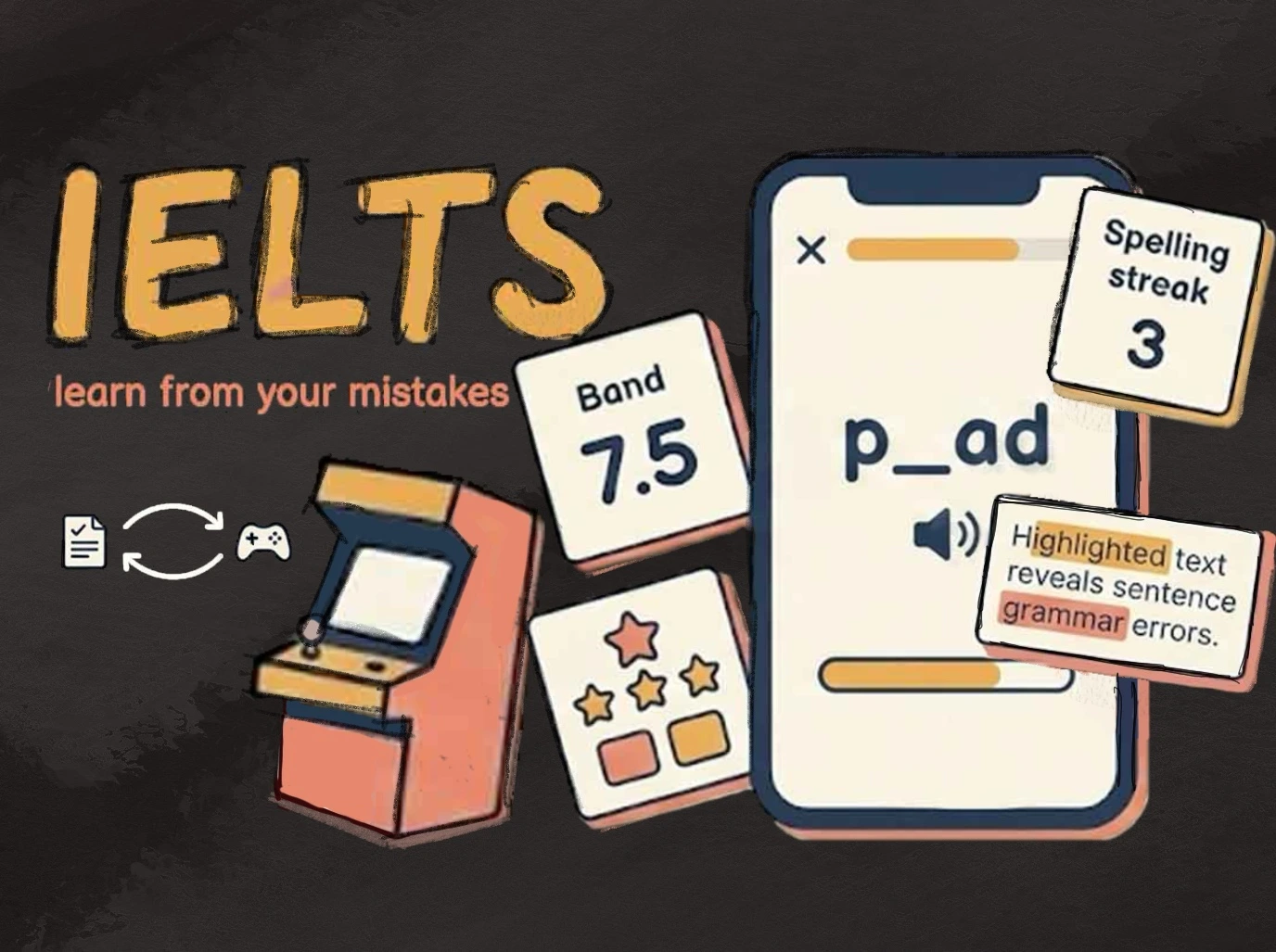
Reimagining how people prepare for the IELTS exam.
More than 3.5 million people take the IELTS every year, yet most preparation tools look almost identical: practice tests, vocabulary lists, subscription tiers, and paywalls. The thinking behind many of these tools usually starts with the same question: How do we capture a share of this market?
This project began with a different set of questions:
What would the best possible IELTS preparation system look like if the goal was results — not revenue?
What does everything I know about self-directed learning, autodidacticism, and building expertise across disciplines tell me about how this system should actually work?
How can the same mechanisms that make habits stick and games compulsive — feedback loops, progression, streaks, variable rewards — be used to serve a learner's goals rather than exploit them?
Why This Probably Shouldn't Exist
The IELTS preparation market is already crowded. There are countless apps, websites, YouTube channels, coaching centers, and practice books promising to help students improve their scores. Many of them are profitable businesses with large user bases and established marketing pipelines. From a purely strategic perspective, building another IELTS preparation tool makes little sense. The market appears saturated. But saturation does not necessarily mean the problem is solved. Most existing platforms share the same structural limitations: practice tests are treated as products rather than learning systems, feedback is minimal, and preparation is rarely personalized around a learner's actual weaknesses. In other words, the tools exist — but the learning loop is broken. This project exists because that gap is still wide open.
A Different Philosophy
Many IELTS apps are designed primarily as businesses. Features are often chosen because they are easy to monetize rather than because they meaningfully improve learning outcomes.
- Essential feedback is locked behind subscriptions.
- Practice tests are artificially limited.
- Vocabulary tools exist mainly to justify premium upgrades.
This project rejects that approach.
The goal is simple: Build the most effective IELTS preparation system available.
Not slightly better. Not competitive.
Substantially better than anything currently on the market.
The Core Idea
The most valuable study material a student has is their own mistakes. Traditional preparation treats practice tests as an endpoint: take the test, receive a score, and move on. But meaningful learning happens after the test, when weaknesses become visible. This platform is designed around a continuous feedback loop where mistakes made during practice become the foundation for targeted training. Instead of repeatedly solving generic exercises, learners train the specific weaknesses that are holding their scores back through focused, game-based practice.
A System, Not a Tool
Most IELTS apps are collections of isolated features. This project is designed as a complete preparation environment, where practice testing, feedback, and skill training work together as a single learning loop. Many implementation details remain intentionally undisclosed while the product is still in development, but the guiding principles are simple:
- Practice should generate learning data
- Training should target demonstrated weaknesses
- Progress should be measurable over time
- Preparation should mirror the real exam environment
- Practice should compete with distraction and win
Everything in the system exists to reinforce these ideas.
Current Status
The platform is fully built and already functional internally. It has already proven useful in the most immediate way possible — I used it myself to prepare for the IELTS exam and achieved a Band 8.
A soft launch is planned for April 1, 2026, where the system will be tested with an initial cohort of learners. The goal of this phase is refinement: observing how real students use the platform and continuously improving the system.
Role: Product Design · System Architecture · Engineer
Built and designed by Abrar Shams Chowdhury
Status: soft launch — April 2026