POBE
Learning Physics Through Mechanics
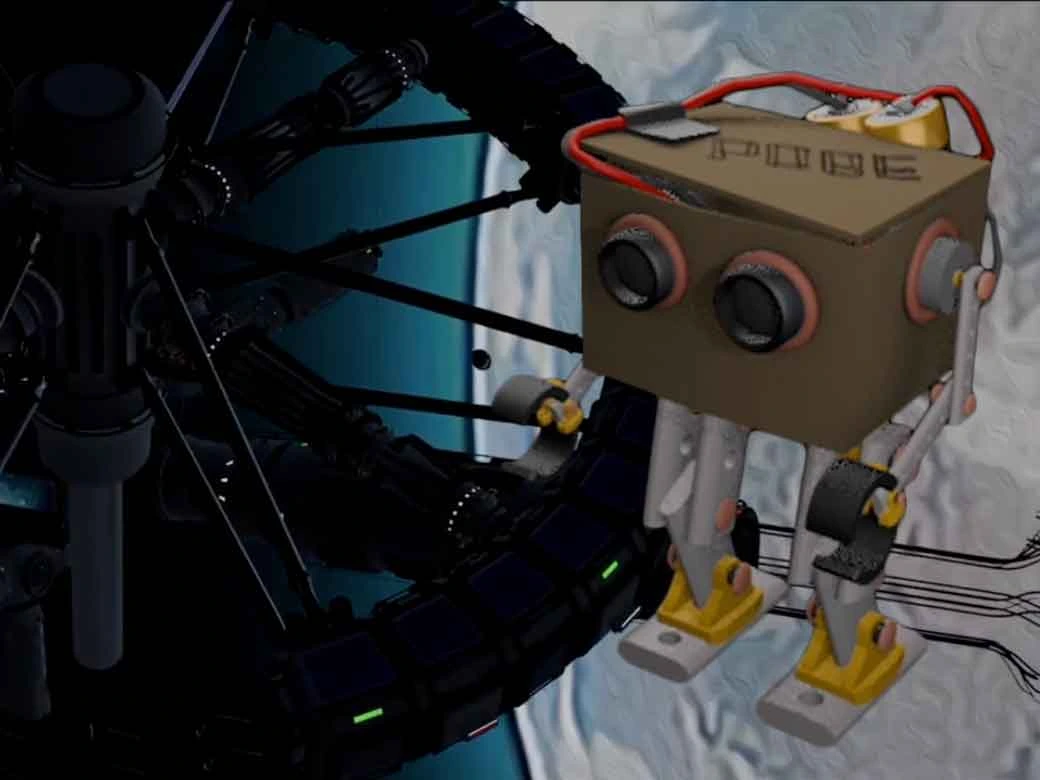
POBE is a curious little robot built for studying curiosity itself. It was never meant to go into space. Due to a clerical error in mission assignments, however, POBE ends up launched to a damaged orbital station. Waiting for it there is the station's AI commander: Atlas. Atlas assigns the robot its first repair task. POBE immediately admits it has no idea how to do it. It doesn't understand motion, force, or momentum. With no other repair bots available, Atlas makes a decision: If POBE is going to save the station, it will have to learn physics one step at a time.
Learning Physics Through Mechanics
The game teaches physics through the systems the player interacts with. POBE does not have thrusters. Instead, it discovers emergency fire extinguishers stored around the station and uses them as improvised propulsion devices. Different extinguishers produce different amounts of thrust, allowing the player to control the force applied. POBE can also equip different robotic suits, each changing the robot's mass and stability. Together, these mechanics recreate the relationship behind Newton's second law:
F = ma
- Force comes from the extinguisher.
- Mass comes from the suit.
- Acceleration is something the player feels through movement.
Early cutscene — the spacecraft delivering POBE to the damaged orbital station.
Discovering Newton's Laws
The game progresses through the three laws of motion.
Newton's First Law — Inertia
POBE pushes off a surface and begins drifting. With no external force applied, the robot continues moving forever. Players must learn to glide through debris fields using inertia alone.
Newton's Second Law — Force and Mass
Different extinguisher thrust levels and suit masses create different acceleration behaviors. Moving heavy cargo requires experimenting with combinations of force and mass. Players begin to understand the relationship behind F = ma through experimentation.
Newton's Third Law — Action and Reaction
Pushing a floating object sends POBE drifting backward. Every action produces an equal and opposite reaction. Repair tasks begin to involve balancing recoil forces while manipulating station components.
The Learning Structure
The game follows a simple learning loop:
- Short narrative setup from Atlas explaining the problem
- Practice interaction with the relevant mechanic
- Mission challenge applying the concept in a real task
By the final mission, players combine all three laws to repair critical systems across the station.
Physics is not presented as a set of abstract rules.
It emerges naturally from the behavior of the environment.
Inspiration
The tone and atmosphere draw inspiration from:
- WALL-E — quiet space scenes and curious robotic characters
- ADR1FT — floating through debris and repairing a damaged station
These influences helped shape the idea of learning physics through movement and exploration.
Making POBE
A short clip from during development — texture painting the POBE lettering onto the robot's surface in Procreate.
The name is painted directly onto the robot's body as a texture, applied on iPad and baked into the 3D model.
Painting the POBE lettering onto the robot's surface.
The Long Vision
Right now the project focuses only on Newtonian mechanics. But the long-term ambition is much larger. One day, I would love to build an interactive system that gradually covers the full range of advanced secondary-school physics, including:
- Mechanics
- Electricity and Magnetism
- Waves and Optics
- Orbital mechanics and gravity
Each concept would live inside an environment where learners use the physics directly instead of memorizing formulas. It is an ambitious idea. Too large for one person to build all at once.
Why This Is My Numero Uno Side Project
For now, the approach is simple.
- Build smaller experiments.
- Test ideas.
- Refine mechanics.
And keep working in the same direction. Someday, when the scope becomes large enough, the goal is to gather a small team of curious collaborators and continue building together. Until then, POBE remains my most important ongoing side project — an attempt to keep exploring what experiential learning might look like for physics.
Why I Keep Building These
MathaVerse asked whether algebra could be understood spatially. POBE asks whether physics can be understood physically. Both projects come from the same belief: Some ideas become clearer when they are experienced rather than explained. If algebra can be walked through, and physics can be felt, then learning might begin to resemble exploration rather than memorization. And that is an experiment I plan to keep running for a long time.
Concept Design & Development — Abrar Shams Chowdhury
Status: concept design complete · early prototype built in Unity